
Not All Bone Marrow Concentrate (BMAC) Treatments Are the Same: Why Technique Matters
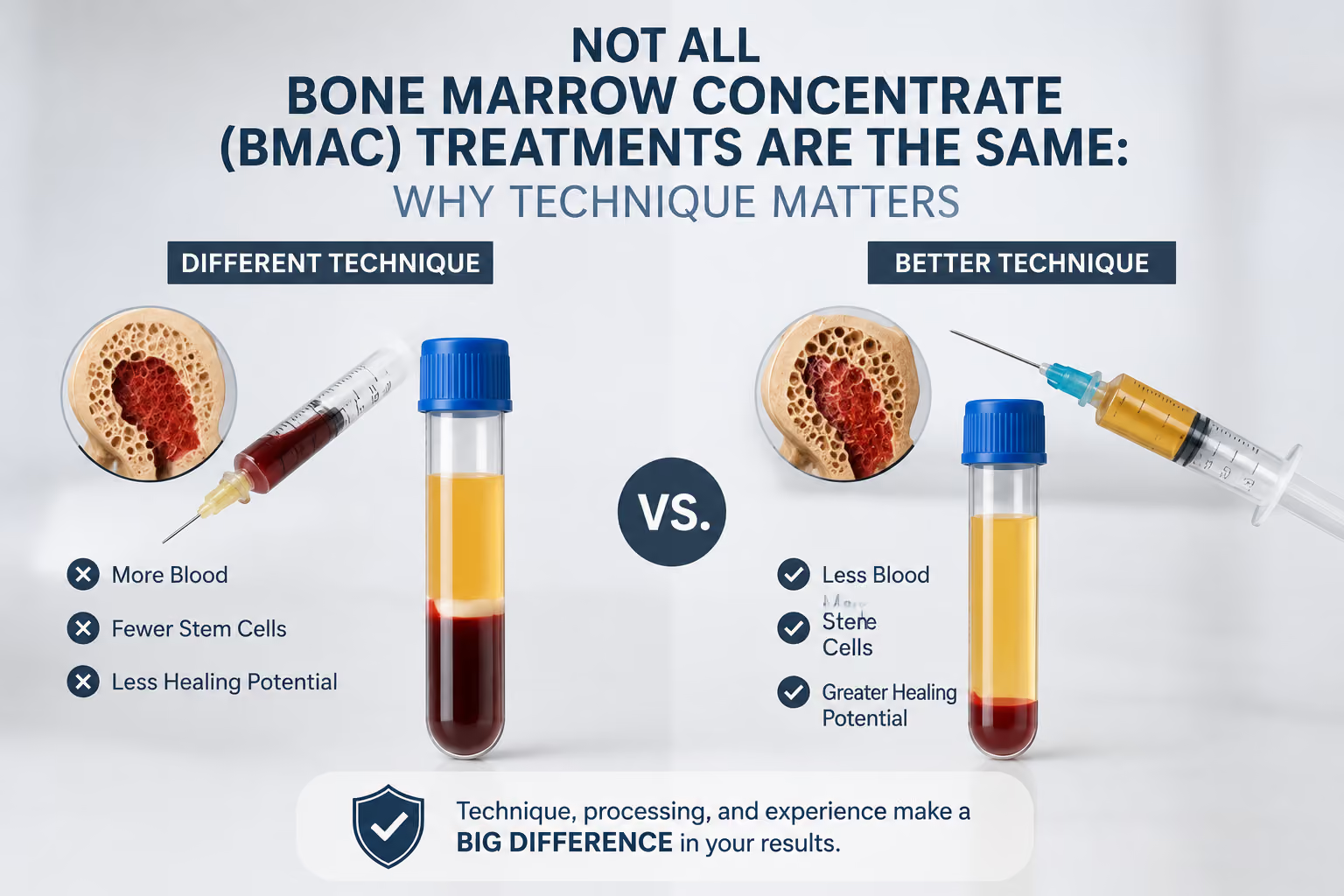
Not All Bone Marrow Concentrate (BMAC) Treatments Are the Same
If you've been researching bone marrow concentrate (BMAC) or stem cell therapy, you've probably noticed something confusing.
One clinic promises incredible results.
Another recommends a completely different procedure.
Prices can vary from a few thousand dollars to well over $10,000.
So who's right?
The truth is that not all BMAC treatments are created equal.
Just because two clinics advertise "bone marrow concentrate" does not mean they are delivering the same treatment.
Recent research has shown that the final biologic product can vary dramatically depending on how it is collected, processed, and delivered.
Understanding these differences can help you make a more informed decision about your care.
First, What Is BMAC?
Bone marrow aspirate concentrate (BMAC) is made from a small amount of your own bone marrow, usually collected from the back of the pelvis.
After collection, the marrow is processed to concentrate many of the body's naturally occurring healing components, including:
- Platelets
- Growth factors
- Anti-inflammatory proteins
- Immune cells
- A small population of progenitor cells, often called stem cells
These components work together to support healing.
That is why many experts now prefer to think of BMAC as a biologic treatment, not simply a stem cell injection.
Why Doesn't Every BMAC Procedure Produce the Same Product?
Imagine asking ten chefs to bake the same cake.
Even if everyone starts with flour, eggs, and sugar, the finished cakes will not be identical.
The same principle applies to BMAC.
The final concentrate depends on many variables, including:
- How the bone marrow is collected
- How much marrow is collected
- Which processing system is used
- How much concentrate is injected
- Where it is injected
- The patient's own biology
Each of these factors may influence the final product.
Harvest Technique Matters
One of the biggest differences between clinics is how the bone marrow is collected.
Research has shown that aspiration technique can influence the number and type of cells collected.
Drawing too much marrow from a single location may dilute the sample with peripheral blood.
Many physicians therefore collect smaller amounts from multiple locations within the pelvis to improve the quality of the aspirate.
Although techniques vary among experienced physicians, careful harvesting is an important part of producing a high-quality concentrate.
Processing Systems Are Different
After the marrow is collected, it is processed in a centrifuge.
Different commercial systems produce different final products.
Some concentrate more platelets.
Some recover more nucleated cells.
Others produce different concentrations of white blood cells or anti-inflammatory proteins.
Studies comparing processing systems have shown substantial variation in the final biologic composition.
This means two patients receiving "BMAC" at different clinics may actually receive biologic products with very different characteristics.
Does Dose Matter?
One of the biggest questions researchers are trying to answer is:
How much BMAC is enough?
Unlike many medications, there is currently no universally accepted dose for bone marrow concentrate.
Researchers continue to study whether factors such as:
- Total nucleated cell count
- Platelet concentration
- Progenitor cell concentration
- Anti-inflammatory protein levels
- Injection volume
influence clinical outcomes.
The honest answer today is that we still don't know the ideal dose for every condition.
What we do know is that dose is likely one piece of a much larger puzzle.
Your Health Matters More Than You Think
At LifeStem, we often tell patients:
"Your body is your own pharmacy."
Every BMAC treatment starts with your own bone marrow.
That means the quality of the final biologic is influenced by your overall health.
Research suggests that factors such as:
- Diabetes
- Smoking
- Obesity
- Chronic inflammation
- Poor nutrition
- Vitamin deficiencies
- Advanced age
may influence the biology of bone marrow and the body's ability to heal.
That is one reason we frequently evaluate metabolic health before recommending regenerative medicine.
Improving your overall health may improve your body's response to treatment.
Precision Is Just as Important as the Biologic
Even an excellent biologic cannot help if it is placed in the wrong location.
This is why image guidance is so important.
Using ultrasound or fluoroscopy allows the physician to visualize the injured tissue and accurately place the biologic where it is intended.
For conditions involving tendons, ligaments, joints, or the spine, precision can make a significant difference.
Experience Matters
BMAC is more than a simple injection.
It involves:
- Choosing the right patient
- Making the correct diagnosis
- Selecting the appropriate biologic
- Harvesting the bone marrow
- Processing the concentrate
- Delivering it accurately
- Guiding rehabilitation afterward
Each step contributes to the overall treatment.
No biologic can overcome an incorrect diagnosis or poor injection technique.
What Does the Research Tell Us?
Recent studies consistently show that BMAC can improve pain and function for many orthopedic conditions, including:
- Knee osteoarthritis
- Partial rotator cuff tears
- Certain tendon injuries
- Early osteonecrosis
- Some spine conditions
At the same time, researchers also recognize that outcomes vary considerably between studies.
One major reason is that there is currently no universal standard for harvesting, processing, dosing, or delivering BMAC.
This is why ongoing research is focused not only on whether BMAC works, but also on which techniques produce the best results for specific conditions.
The LifeStem Difference
At LifeStem Regenerative Medicine, we believe that successful regenerative medicine depends on far more than simply injecting bone marrow concentrate.
Unlike many heavily advertised national regenerative medicine chains—where patients are often evaluated briefly, with no imaging, and then receive a “one-size-fits-all” injection performed by a physician assistant or nurse practitioner who underwent limited weekend-based training—our approach is fundamentally different.
Dr. Adams brings advanced training in interventional orthopedics and years of dedicated experience performing image-guided regenerative procedures. Every patient is personally evaluated by a physician with deep expertise in musculoskeletal diagnosis, ultrasound and fluoroscopic guidance, and biologic treatment planning.
We focus on the entire process:
- Careful diagnosis performed by a physician with advanced musculoskeletal training
- Advanced imaging and precision-guided evaluation
- Comprehensive assessment of your overall health and contributing factors
- Thoughtful, individualized patient selection
- Physician-performed, image-guided bone marrow harvesting and injection
- Evidence-based rehabilitation planning
- Treatments grounded in the latest peer-reviewed research and biologic science
Our goal is not simply to perform a procedure.
Our goal is to provide the right biologic, in the right place, for the right patient, at the right time.
The Bottom Line
Bone marrow aspirate concentrate is one of the most exciting developments in orthopedic regenerative medicine.
But patients should understand that BMAC is not a standardized product.
The biology of the patient, the harvesting technique, the processing system, the biologic dose, and the precision of the injection may all influence the final treatment.
As the science continues to evolve, one principle has become increasingly clear:
The success of regenerative medicine depends on much more than what is inside the syringe.
It depends on thoughtful diagnosis, careful preparation, precise technique, and selecting the right treatment for the right patient.
If you are considering BMAC treatment for an orthopedic condition, choose a physician who understands both the science behind the biologic and the importance of delivering it with precision.