
Can Bone Marrow Concentrate (BMAC) Help Degenerative Disc Disease?
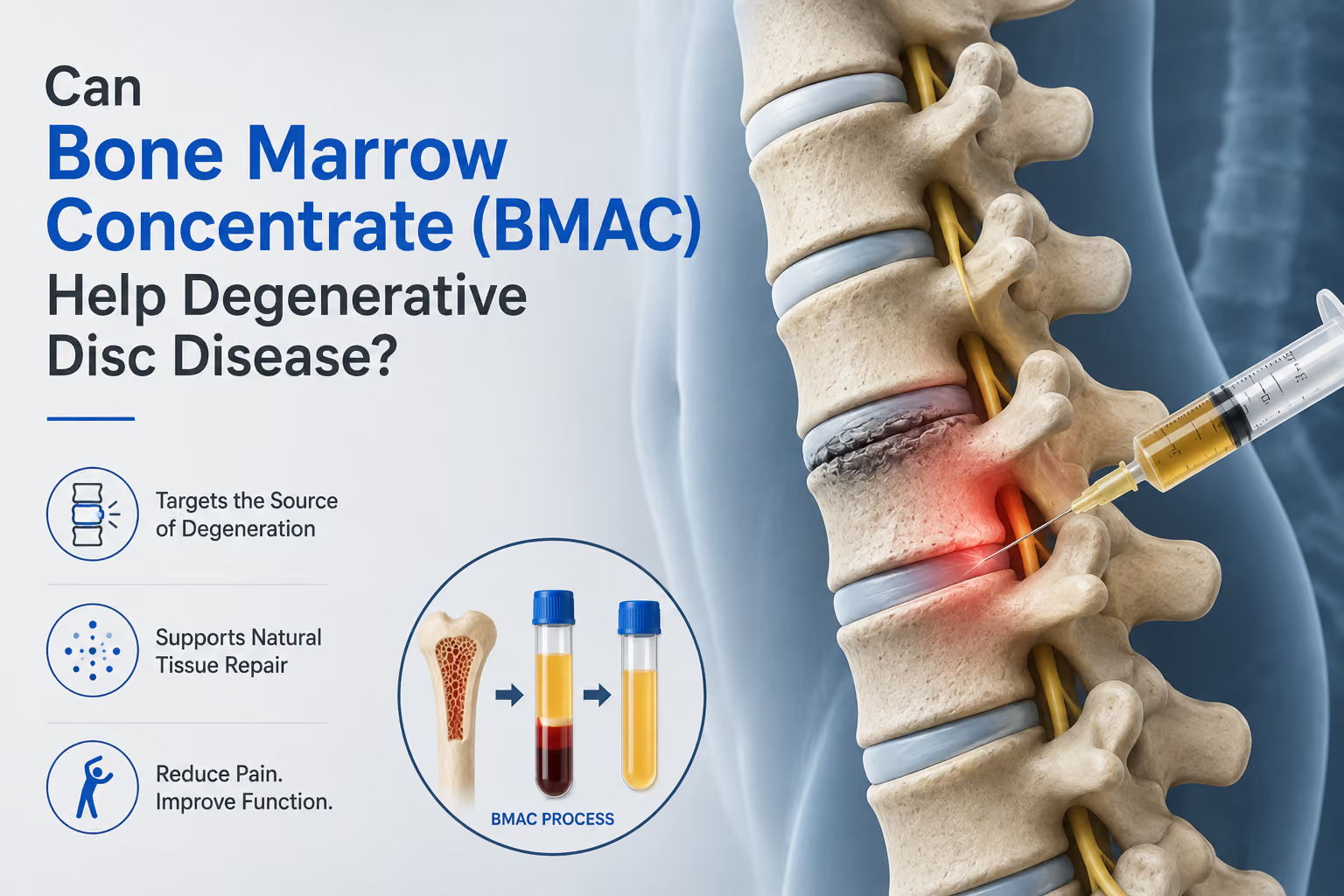
Can Bone Marrow Concentrate (BMAC) Help Degenerative Disc Disease?
If you've lived with chronic low back pain, you've probably heard the same recommendations over and over:
- Physical therapy
- Anti-inflammatory medications
- Muscle relaxers
- Steroid injections
- Chiropractic care
- "Learn to live with it."
- Surgery
While these treatments can help some patients, many continue to struggle with pain that interferes with work, exercise, travel, and everyday life.
For some people, the pain isn't coming from a pinched nerve or arthritis.
It's coming from the disc itself.
This is called discogenic low back pain, and it has become one of the most exciting areas of research in regenerative medicine.
Growing evidence suggests that bone marrow aspirate concentrate (BMAC) may help reduce pain and improve function in carefully selected patients with degenerative disc disease.
Let's look at what today's research tells us.
What Is Degenerative Disc Disease?
Despite its name, degenerative disc disease is not really a disease.
It is a gradual process in which the discs between the bones of the spine begin to lose water, elasticity, and strength.
Healthy discs act like shock absorbers.
As they wear down, they become less able to cushion the spine.
Tiny cracks can develop in the outer layer of the disc.
Inflammatory chemicals are released.
Pain-sensitive nerve fibers may grow into areas of the disc where they normally do not exist.
For some patients, the disc itself becomes the source of chronic pain.
This is known as discogenic low back pain.
Not Every MRI Finding Causes Pain
One of the most important things patients should understand is this:
An abnormal MRI does not automatically explain your symptoms.
Many adults have bulging discs or degenerative changes that cause no pain at all.
Likewise, someone with severe pain may have only modest MRI changes.
This is why simply finding a "bad-looking disc" on MRI is not enough to diagnose discogenic pain.
A careful history, physical examination, imaging review, and sometimes diagnostic procedures are needed to determine whether the painful disc is truly responsible for your symptoms.
At LifeStem, we believe that making the correct diagnosis is every bit as important as selecting the correct treatment.
What Does Discogenic Pain Feel Like?
Patients often describe:
- Deep aching pain in the lower back
- Pain that worsens after prolonged sitting
- Difficulty standing after sitting
- Pain when bending forward
- Pain when lifting
- Morning stiffness
- Difficulty driving long distances
Unlike sciatica, discogenic pain usually does not travel far down the leg.
If leg pain is present, it is often much less severe than the back pain itself.
What Is Bone Marrow Aspirate Concentrate (BMAC)?
Bone marrow aspirate concentrate is produced from a small amount of your own bone marrow, usually collected from the back of the pelvis during a brief procedure performed under local anesthesia.
The marrow is processed during the same visit to create a concentrated biologic treatment containing:
- Platelets
- Growth factors
- Anti-inflammatory proteins
- Immune cells
- A small population of progenitor cells, commonly called stem cells
Contrary to many advertisements, BMAC is not simply a stem cell injection.
It is a complex biologic product designed to support the body's natural healing response.
Researchers believe these biologic components may help reduce inflammation inside the painful disc and improve the environment surrounding damaged disc tissue.
Can BMAC Regrow a Degenerated Disc?
This is one of the biggest questions in regenerative medicine.
The honest answer is:
We don't know.
Animal studies have shown encouraging evidence that bone marrow-derived cells may influence disc biology.
However, human studies have not consistently demonstrated that BMAC restores a severely degenerated disc to its normal appearance.
What current research does suggest is that many carefully selected patients experience:
- Less pain
- Better function
- Improved quality of life
Those improvements may occur even if the MRI changes very little.
For many patients, improving daily function is ultimately more important than changing the appearance of an MRI.
What Does the Research Show?
The scientific evidence for intradiscal BMAC has grown steadily over the past several years.
Systematic reviews published since 2022 have found that patients with carefully selected discogenic low back pain often experience meaningful improvements in pain and disability after intradiscal BMAC treatment.
Several prospective studies have reported significant improvements in pain scores, physical function, and quality of life lasting one year or longer after treatment.
Perhaps most encouraging is the consistency of these findings.
Although study sizes remain relatively small, multiple research groups have reported similar improvements in appropriately selected patients.
At the same time, the medical literature also recognizes important limitations.
Most studies include relatively few patients.
Different physicians use different harvesting techniques, processing systems, rehabilitation protocols, and patient selection criteria.
For these reasons, larger randomized clinical trials are still needed before BMAC can be considered standard treatment for degenerative disc disease.
Nevertheless, the current evidence is encouraging enough that many spine specialists believe intradiscal BMAC represents one of the most promising biologic treatments currently under investigation.
Why Proper Diagnosis Is So Important
One of the biggest mistakes in spine care is assuming that every patient with degenerative discs has discogenic pain.
That simply isn't true.
Low back pain may originate from:
- Degenerated discs
- Facet joints
- Sacroiliac joints
- Ligaments
- Muscles
- Nerve compression
- Hip disorders
- Multiple structures at the same time
Treating the wrong structure rarely produces good results.
This is why identifying the true pain generators is one of the most important parts of the evaluation.
Why Image Guidance Matters
Injecting the intervertebral disc is one of the most technically demanding procedures in regenerative medicine. This procedure can only be safely performed by a physician who specializes in the spine and has extensive training. It requires the use of a fluoroscope, which is a type of live video X-ray machine that costs over $100,000. Therefore, if you happen to talk to a physician, physician assistant, or nurse practitioner who claims they can treat your disc in your home, or even in the office without the proper equipment and training, run away.
The needle must be placed precisely into the center of the painful disc while avoiding nearby nerves and other sensitive structures.
At LifeStem, these procedures are performed by a spine specialist with 30 years of experience using advanced fluoroscopic image guidance to maximize accuracy and safety.
Precision matters.
Who May Be a Good Candidate?
You may be a candidate for BMAC if you have:
- Chronic low back pain lasting several months or longer
- Imaging consistent with degenerative disc disease
- Symptoms suggesting discogenic pain
- Failure of appropriate conservative treatment
- A desire to avoid spine surgery if appropriate
Patients with severe spinal instability, advanced nerve compression, significant neurologic deficits, spinal infection, or certain other conditions may require different treatments, including surgery.
A comprehensive evaluation is essential before making treatment recommendations.
The LifeStem Difference
At LifeStem Regenerative Medicine, we understand that low back pain is rarely simple.
Every patient receives a detailed evaluation that includes a comprehensive history, physical examination, and careful review of imaging. We focus on identifying the true source of pain rather than assuming every abnormal MRI finding requires treatment.
When BMAC is recommended, procedures are performed using advanced fluoroscopic guidance to accurately target the painful disc. We also evaluate factors that influence healing—including metabolic health, inflammation, nutrition, and overall wellness—because successful regenerative medicine begins long before the procedure itself.
Our goal is simple:
Provide the right biologic, in the right place, for the right patient, at the right time.
The Bottom Line
Degenerative disc disease does not automatically mean you need spine surgery.
For carefully selected patients with discogenic low back pain, growing research suggests that bone marrow aspirate concentrate (BMAC) may reduce pain, improve function, and help patients return to activities they enjoy.
Although larger clinical trials are still needed, today's evidence supports BMAC as one of the most promising regenerative treatments currently available for chronic discogenic low back pain.
The key is selecting the right patient and making the right diagnosis.
If you have been told you have degenerative disc disease and want to explore your options before considering spine surgery, a consultation at LifeStem Regenerative Medicine can help determine whether BMAC, PRP, or another treatment may be appropriate for your specific condition.